
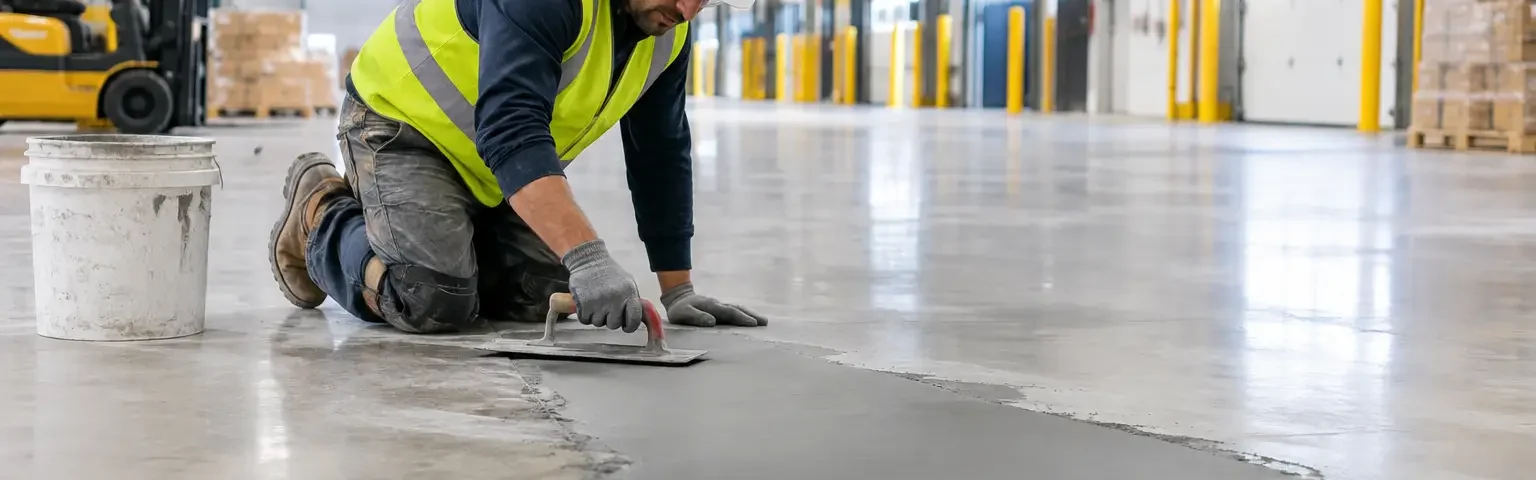
A distribution center floor repair example often begins with a familiar complaint: forklifts are hitting broken joints hard enough to rattle loads, concrete is chipping along traffic lanes, and maintenance crews are filling the same damaged areas again and again. The visible damage may occupy only a few hundred square feet, but the underlying issue can affect safety, equipment wear, sanitation, and daily throughput across the building.
The right repair is not simply a matter of placing patch material in broken concrete. In an active distribution environment, the repair has to account for slab movement, forklift wheel loads, joint geometry, moisture conditions, traffic patterns, and the time available to close a lane. That is why successful concrete restoration starts with an evaluation of why the floor failed.
Distribution Center Floor Repair Example: Failed Joints in Forklift Lanes
Consider a distribution center with repeated spalling at control joints in its main forklift travel aisles. The slab surface is generally sound, but joint edges have broken away in sections ranging from a few inches to several feet long. Some previous patching has already failed, leaving loose material and uneven transitions that increase impact every time a loaded forklift passes over the joint.
This type of failure is common where hard forklift wheels repeatedly cross joints. As concrete edges deteriorate, the wheels strike a sharper vertical edge. That impact breaks more concrete, which makes the joint rougher and accelerates damage. A repair that only fills the chipped area without rebuilding the joint edge and addressing the joint itself will often fail under the same traffic.
The first step is to identify whether the joint is behaving as intended. Some joints are designed to control shrinkage cracking and may have opened over time. Others may show differential movement, poor load transfer, or damage from equipment that is heavier than the original slab design anticipated. Moisture-related deterioration, inadequate earlier repairs, and poor concrete consolidation near the joint can also be contributing factors.
The Repair Scope
For a durable result, damaged concrete is saw cut beyond the weak or fractured edges. This creates sound, clean repair boundaries rather than trying to bond new material to crumbling concrete. Crews remove the failed sections, mechanically prepare the exposed concrete, and clean the area thoroughly so repair materials can achieve proper bond.
The joint profile then needs to be restored with a repair system selected for the loading and movement conditions. In high-traffic forklift lanes, a rigid or semi-rigid joint filler may be used where appropriate to support joint edges and reduce impact. The material choice depends on the joint’s purpose, expected movement, temperature conditions, and the facility’s operating requirements. A product that performs well in a stable, climate-controlled warehouse may not be the right choice for a cold storage area or a loading zone exposed to moisture.
Once the repair has cured to the specified strength, the surface is ground flush. A smooth transition matters. Even a small elevation difference can continue to create wheel impact, accelerate wear, and produce a rough ride for operators. In a busy distribution center, the finish is judged not only by how it looks on completion day, but by how it performs after thousands of loaded crossings.
Why Standard Patch Repairs Fail
Many distribution center floor repairs fail because the damaged area is treated as an isolated surface defect. The patch may look acceptable at first, but it can debond or fracture when the original cause remains in place.
Poor preparation is one of the most common problems. Concrete contaminated by dust, tire residue, oils, or prior coatings cannot provide a dependable bonding surface without proper mechanical preparation. A repair material also needs a clean, sound concrete substrate. Applying it over weakened concrete simply transfers the failure line below the repair.
Material selection is another issue. Fast-setting products can be useful when downtime is limited, but speed alone does not make a repair suitable for heavy industrial traffic. The repair needs enough compressive strength, bond strength, abrasion resistance, and compatibility with the movement at the location. At joints, the wrong material can crack at the edge, pull away, or become too hard and brittle for the service condition.
Timing matters as well. Closing a traffic lane for a few hours can be difficult, especially during peak shipping periods. Yet reopening the area before the repair reaches its required service strength can damage a new installation before it has had a fair chance to perform. A repair plan should be built around actual operations, including shift changes, staging space, dock activity, and forklift routes.
Evaluating the Entire Floor, Not Just the Worst Area
A failed joint in one aisle can be a warning sign rather than a one-off maintenance issue. Before approving a spot repair, facility managers should look at the broader pattern. Are failures concentrated near dock doors? Do they occur in the heaviest picking lanes? Are joints in the same direction or slab section showing similar distress? Is water entering through exterior openings, washdown areas, or damaged sealants?
A practical evaluation reviews traffic loads and wheel types, joint condition, slab cracking, surface wear, moisture exposure, and previous repair history. It also considers whether operational changes have increased demands on the floor. A building designed for lighter pallet jacks and occasional forklifts may now be carrying high-volume, narrow-aisle equipment and heavier loaded traffic throughout the day.
In some cases, targeted joint repair is the right answer. In others, widespread spalling, scaling, or surface deterioration may call for a larger industrial concrete repair program. If the facility needs a cleanable, chemical-resistant finish in a particular zone, a high-performance system such as urethane cement flooring may be considered after concrete repairs are complete. The correct scope depends on the condition of the slab and the work the floor is expected to do.
Planning Repairs Around Distribution Operations
The best floor repair plan respects the reality that distribution centers cannot simply stop moving product. Work may need to be completed in phases, with one aisle, staging area, or dock lane taken out of service at a time. Clear traffic control and coordination with operations are essential. A technically correct repair can still create avoidable disruption if crews block a primary travel route without a workable rerouting plan.
Phased work also gives facility teams an opportunity to prioritize the highest-risk areas first. Locations with loose concrete, severe forklift impact, trip hazards, or damage that threatens product stability should move to the front of the schedule. Less critical cosmetic wear can be addressed later if the underlying slab remains sound.
For facilities with sanitation requirements, repairs must also be compatible with cleaning practices. Food distribution, beverage operations, and commercial kitchens may need a floor system that handles moisture, cleaning chemicals, and frequent washdown without breaking down at repaired transitions. Where those conditions exist, the repair detail and protective flooring system should be designed together instead of treated as separate projects.
What a Durable Result Looks Like
A completed distribution center repair should leave forklift routes smooth, joint edges supported, and damaged concrete removed back to sound material. The repair should not create a proud edge, low pocket, or abrupt change in texture that catches wheels or collects debris. It should be ready for the actual traffic and cleaning conditions of the facility, not a lighter-duty version of them.
Just as important, the repair scope should make business sense. There is a trade-off between the smallest possible repair today and the repair that reduces repeated maintenance, equipment abuse, and downtime over the next several years. A contractor with industrial flooring experience can help define that line by matching the system to the failure mechanism and the facility’s operations.
For Tennessee distribution centers, a field evaluation by an experienced concrete restoration contractor can turn recurring floor damage into a defined, manageable repair plan. The goal is not to make a patch disappear for a month. It is to return the floor to safe, reliable service and give operations one less recurring problem to manage.
Need a commercial or industrial flooring solution? TKO Concrete Coatings provides concrete restoration and high-performance flooring systems for manufacturing plants, food-processing facilities, warehouses, commercial kitchens, breweries, and other demanding environments. Visit TKOConcrete.com to discuss your project or request an evaluation.
