
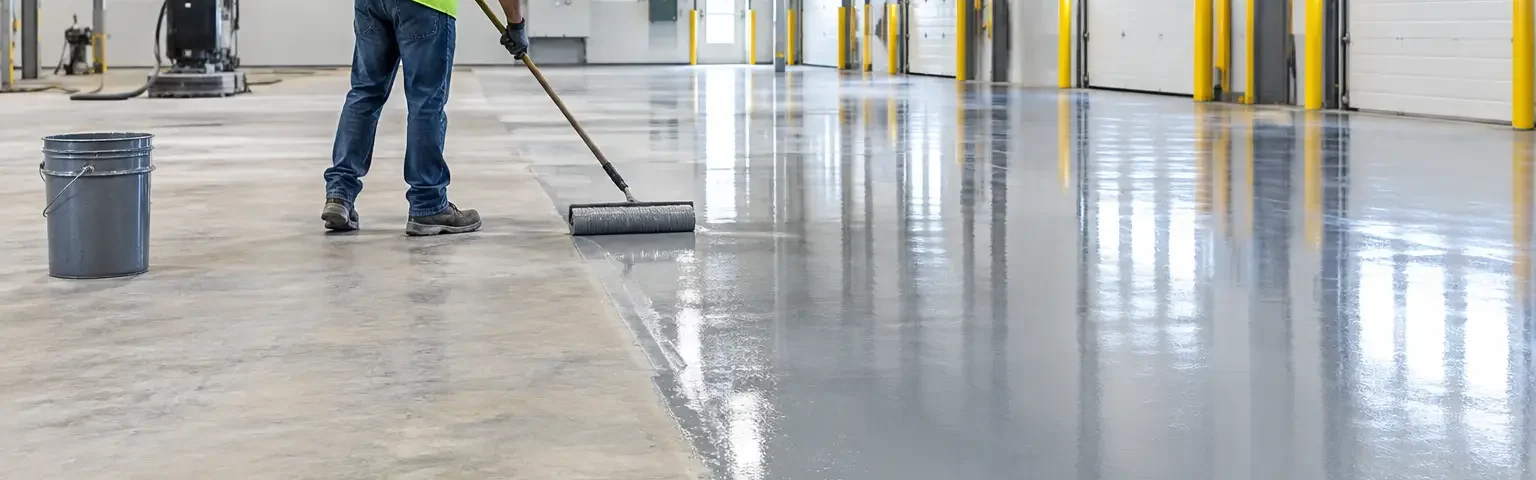
A maintenance garage can look serviceable until a failed coating starts trapping oil, holding wash water, and breaking apart under tire traffic. This garage floor coating guide is written for commercial and industrial facilities that need a floor system to support the work happening on it – from fleet maintenance bays and equipment garages to manufacturing service areas, loading zones, and washdown spaces.
The right answer is rarely just “epoxy.” Coating selection depends on the slab condition, moisture level, traffic, chemical exposure, cleaning methods, temperature swings, shutdown window, and safety requirements. A finish may look good on day one and still be the wrong system for the operation.
Start With the Failure, Not the Color
A floor coating project should begin with an evaluation of why the existing surface is failing. Peeling coatings, dusting concrete, tire marks, joint damage, scaling, and soft spots can each point to a different underlying problem. Covering those conditions without addressing them usually creates a shorter-lived version of the same failure.
For example, a coating that releases in sheets may be dealing with moisture vapor moving through the slab, poor mechanical preparation, contamination from oils or silicones, or an incompatible prior coating. Concrete that is breaking down around drains, lifts, or wheel paths may need concrete repair before any resinous material is installed. Cracks and failing joints need to be evaluated for movement and load transfer, not simply filled at the surface.
This is where experienced commercial flooring contractors separate a coating installation from a flooring solution. The system is only as dependable as the concrete and preparation beneath it.
What a Commercial Garage Floor Must Withstand
Commercial garages and service areas create a different set of demands than ordinary occupied spaces. Forklifts, service trucks, pallet jacks, carts, lifts, and rolling equipment concentrate stress in predictable travel lanes. Tire traffic can generate heat and shear forces that challenge poorly bonded coatings. In facilities with frequent cleaning, moisture can enter weak spots at joints, drains, edges, and prior repairs.
Chemical exposure matters just as much. Motor oils, lubricants, fuels, hydraulic fluid, battery acid, degreasers, detergents, and process chemicals can stain or attack unprotected concrete. A facility that occasionally sees a small spill needs a different system than one that performs daily washdowns or handles aggressive cleaning chemistry.
Slip resistance also requires practical judgment. A heavily textured surface can improve footing where water or oil is present, but excessive texture may make sweeping, mopping, and equipment movement more difficult. The correct profile balances traction, cleanability, and the work performed in the area.
Garage Floor Coating Guide: Match the System to the Environment
Epoxy, urethane cement, polyaspartic, and polyurethane systems all have legitimate commercial uses. They are not interchangeable.
Epoxy flooring is often a strong option for dry or moderately wet commercial spaces that need good abrasion resistance, a cleanable finish, and resistance to many common chemicals. System thickness, resin chemistry, broadcast aggregate, and topcoat selection all affect performance. Epoxy can be an effective part of a warehouse, maintenance, or production-floor solution when moisture and temperature conditions are properly managed.
Urethane cement flooring is often the better choice where thermal shock, hot washdowns, sustained moisture, sanitation, or severe service conditions are present. Food processing areas, commercial kitchens, breweries, and washdown environments frequently need a more tolerant system than a standard epoxy coating. Its performance under demanding conditions can justify the higher initial investment when premature failure would disrupt operations.
Polyurethane topcoats are commonly used to add wear resistance, chemical resistance, or improved color stability to compatible flooring systems. Fast-cure materials can also help when a tight shutdown window controls the project schedule. Fast return to service is valuable, but it should not override the need for sound substrate preparation, moisture testing, and correct curing conditions.
For areas with significant slab deterioration, a coating is not the first repair. Industrial concrete repair may be required to rebuild damaged sections, restore transitions, repair joints, and create a stable base for the final flooring system.
Preparation Is the Part You Should Not Negotiate
The condition of the slab determines preparation methods. In most commercial projects, mechanical surface preparation is required to create the correct concrete surface profile for bonding. Diamond grinding may be suitable for certain sound surfaces and coating removals. Shot blasting is often used to open concrete across larger areas and provide a consistent profile. Scarification or milling may be needed when thicker coatings, failed materials, or uneven concrete must be removed.
Cleaning alone is not preparation. Degreasers can help address contamination, but oil that has penetrated concrete may require deeper treatment or removal. A contractor should inspect areas around repair stations, service pits, doorways, drains, and equipment locations closely because these zones commonly carry the heaviest contamination and wear.
Moisture testing should be part of the pre-installation process when the system is sensitive to vapor transmission. A slab can appear dry at the surface while still transmitting enough moisture to compromise adhesion. Where moisture levels are elevated, a compatible moisture-mitigation system may be necessary before the coating is installed.
Plan Repairs, Joints, Drains, and Edges as One System
Floors fail at transitions before they fail in the open field. Expansion joints, control joints, drain perimeters, wall edges, equipment pads, and door thresholds all need deliberate detailing. Rigidly filling a moving joint with the wrong material can lead to cracking or edge failure. Leaving a damaged joint untreated allows impact, water, and contaminants to continue breaking down the concrete.
Drainage is particularly important in wash areas and facilities that use pressure washing. If water ponds because the slab has inadequate slope, a new coating will not correct the drainage problem by itself. The project may require localized concrete restoration, drain repair, or slope correction before a finish floor is applied.
Facilities should also consider how repairs will interact with vehicle and equipment routes. A patch that is structurally sound but poorly feathered can become a rough transition that takes repeated impact from wheels. Proper repair design matters as much as the coating installed over it.
Define the Operating Requirements Before Selecting a Finish
Before approving a flooring system, facility teams should be able to answer a few operational questions: What traffic uses the space? What chemicals contact the floor? Is the area wet, dry, or routinely washed down? Are hot materials, steam, or temperature swings involved? How much downtime is available? What cleaning tools and procedures will be used after installation?
Those answers guide the specification. A dry fleet garage with routine vehicle traffic may need a different build than a heavy-equipment maintenance area with oils and frequent washing. A manufacturing service corridor may prioritize abrasion resistance and rapid return to service. A sanitation-sensitive facility may need cove bases, seamless transitions, and a floor designed around washdown and cleaning protocols.
Appearance still has value. Color zoning can identify work areas, aisles, equipment zones, and safety boundaries. But color should follow performance decisions, not lead them.
Installation Timing and Return to Service
A flooring installation affects production, traffic flow, and maintenance schedules. The project plan should account for concrete repairs, surface preparation, cure times, temperature and humidity, material staging, ventilation, and access restrictions. In occupied facilities, phased installation can reduce disruption, but each phase needs clean boundaries and a clear traffic-control plan.
Returning equipment too early is a common cause of damage. A floor can feel dry to the touch before it has developed the strength needed for tires, forklifts, chemical exposure, or heavy loads. The contractor should provide specific return-to-service guidance for foot traffic, wheeled traffic, and full operational use.
A dependable floor is not simply a coating applied to concrete. It is a system built around the condition of the slab and the realities of the facility. When the evaluation, repair, preparation, and material selection are aligned, the result is easier to maintain and better suited to the work that keeps the facility moving.
Need a commercial or industrial flooring solution? TKO Concrete Coatings provides concrete restoration and high-performance flooring systems for manufacturing plants, food-processing facilities, warehouses, commercial kitchens, breweries, and other demanding environments. Visit TKOConcrete.com to discuss your project or request an evaluation.
