
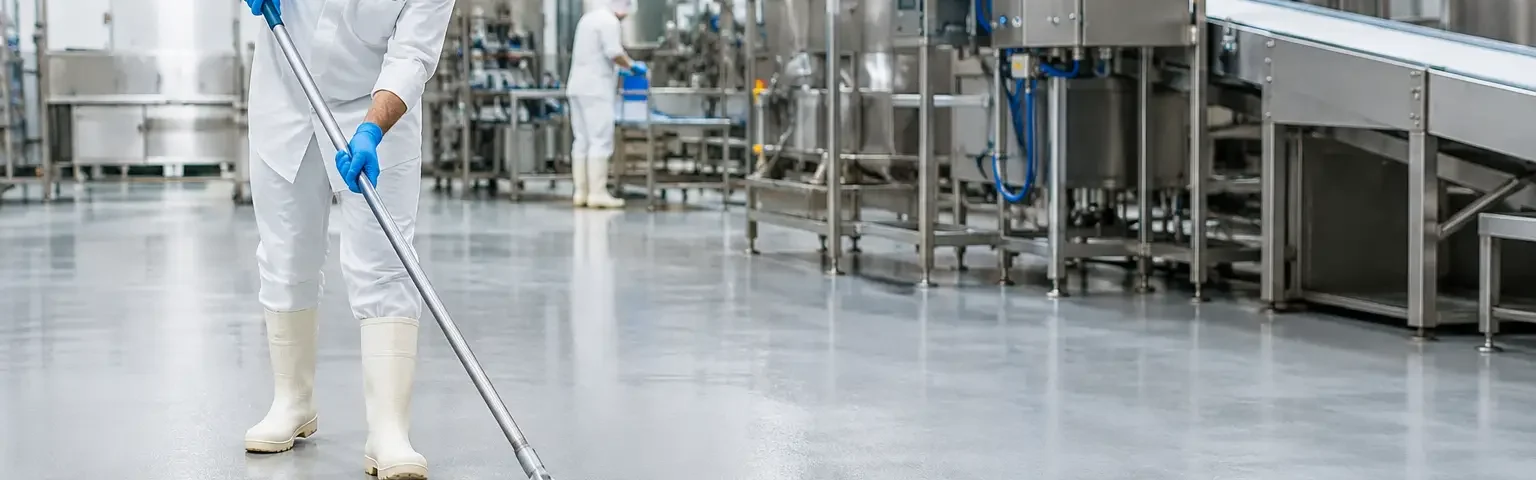
A floor can look clean after a washdown and still be a sanitation problem. Open joints, worn coating edges, cracked concrete, and porous surfaces can hold moisture and organic material where routine cleaning cannot reach. For food plants, commercial kitchens, breweries, and similar operations, choosing the best sanitary flooring materials means looking beyond appearance. The floor must support the way the facility is cleaned, drained, staffed, and operated every day.
The right system is rarely selected by material name alone. Temperature swings, chemical exposure, forklift traffic, moisture vapor, drainage conditions, and downtime windows all affect whether a floor performs for years or begins failing at the first weak point.
What Makes a Flooring System Sanitary?
Sanitary flooring is built around cleanability and durability. It should provide a continuous, nonporous surface that resists water, chemicals, staining, and microbial harborage. Just as important, it must remain intact under the conditions that would otherwise create cracks, delamination, or exposed concrete.
In wet-process environments, smooth transitions matter. Floors should tie into drains correctly, include proper slope where needed, and use integral cove bases at walls, equipment pads, and other transitions. A high-performance coating applied over a failed slab, loose tile, or deteriorated joint is not a sanitary solution. It is a short-term cosmetic layer over an existing failure.
Preparation is where many projects succeed or fail. Concrete may need moisture testing, mechanical profiling, contaminated-surface removal, joint repair, or structural concrete restoration before a new system is installed. Facility managers should treat substrate evaluation as part of the flooring specification, not an optional pre-installation step.
Best Sanitary Flooring Materials by Operating Condition
Urethane Cement for Wet, Hot, and Demanding Areas
Urethane cement is often the leading choice for sanitary production areas with frequent washdowns, thermal cycling, and chemical exposure. It is a resin-rich cementitious system that bonds strongly to properly prepared concrete and is far more tolerant of difficult industrial conditions than many conventional coatings.
Food processing rooms, breweries, commercial kitchens, bottling areas, dishwashing zones, cold-storage transitions, and wash bays commonly benefit from urethane cement flooring. Its performance under hot-water washdowns and thermal shock is a key advantage. A floor that sees hot process liquids followed by cold cleaning water can cause rigid systems to crack or separate from the slab. Urethane cement is designed to better accommodate those stresses.
It can also be installed with broadcast aggregate to improve slip resistance. That texture must be selected carefully. Too smooth can create a safety concern in wet areas; too aggressive can make cleaning more difficult. The goal is a finish that gives employees stable footing without becoming a surface that traps debris.
The trade-off is that urethane cement requires experienced installation and careful attention to thickness, detail work, and curing conditions. It is not a universal answer for every dry warehouse aisle or office-adjacent space, but it is one of the strongest options for severe sanitary environments.
Epoxy Flooring for Controlled Chemical and Traffic Exposure
High-build epoxy flooring remains a practical option in many commercial and industrial facilities. It creates a durable, nonporous surface with strong chemical resistance and can be specified in a range of thicknesses, colors, and texture levels. It performs well in dry or moderately wet environments where cleaning chemicals, cart traffic, light-to-medium equipment traffic, and appearance are priorities.
Epoxy can be a good fit for packaging areas, dry food-production spaces, laboratories, storage rooms, and certain manufacturing zones. It is also useful when color coding, safety striping, or clearly defined work areas support operations.
However, epoxy has limits. Standard epoxy systems are less forgiving under severe thermal shock and may not be the best choice for areas with frequent hot-water washdowns, persistent moisture, or major substrate movement. They also depend heavily on proper moisture mitigation and concrete preparation. If the slab has active moisture vapor transmission or contamination, the specification must address it before epoxy is applied.
Methyl Methacrylate for Fast Turnaround Projects
Methyl methacrylate, commonly called MMA flooring, is a resinous flooring system known for rapid cure times. In the right setting, it can allow a facility to return an area to service much faster than traditional systems. That can be valuable during planned shutdowns, overnight repairs, or phased renovations where downtime is tightly controlled.
MMA can deliver a hygienic, chemical-resistant surface and can be built with slip-resistant aggregate. It is often considered for food and beverage facilities, commercial kitchens, and production spaces that cannot remain offline for long.
The practical consideration is installation control. MMA has a strong odor during application, so ventilation, occupied areas, and work sequencing need to be planned carefully. Fast cure does not eliminate the need for correct concrete preparation, joint treatment, or drain detailing.
Polished Concrete for Dry, Cleanable Operations
Polished concrete can be a durable, low-maintenance choice for dry manufacturing, distribution, retail, and warehouse areas. The process mechanically refines and densifies the concrete surface, reducing dusting and improving cleanability while preserving the slab’s natural appearance.
For facilities with forklift traffic and a need for a hard-wearing floor, polished concrete offers long service life with less concern about coating wear in high-traffic lanes. It can also improve light reflectivity, which helps in large warehouse and production spaces.
It is not typically the first choice for aggressive wet-process sanitation. Polished concrete is not a substitute for a seamless resinous system in areas exposed to standing water, caustic washdowns, food acids, or frequent thermal shock. Its best use is in dry zones where abrasion resistance, appearance, and ease of routine maintenance matter more than liquid containment.
Details That Matter as Much as the Material
A sanitary floor is a system, not just a field coating. The perimeter, drains, penetrations, expansion joints, and damaged slab areas deserve the same attention as the open floor. If those details are ignored, moisture will find the weak points.
Integral cove base is especially valuable in food-processing and commercial-kitchen environments. By creating a curved, continuous transition from wall to floor, it removes the sharp inside corner that is difficult to clean and prone to collecting residue. Cove should be coordinated with wall panels, existing base conditions, and cleaning methods so the completed system remains continuous.
Drainage is equally important. No flooring material can compensate for inadequate slope or drains that sit proud of the surrounding surface. Ponding water creates sanitation, slip, and coating-performance concerns. Before installing a new system, evaluate how water moves across the floor during actual washdown conditions, not just how the slab appears when dry.
Concrete joints require a deliberate plan as well. Some joints must remain functional and receive flexible filler; others may be repaired or rebuilt based on slab movement and traffic needs. Random cracks, spalls, and failing repairs should be addressed before a coating system is installed. This is where engineered industrial concrete repair can prevent recurring failures at the surface.
How to Choose the Right System for Your Facility
Start with the operating environment. Identify whether the area is wet or dry, the temperatures involved, the cleaning chemicals used, expected traffic, and whether food or product contact is possible. Also consider the shutdown window. A technically suitable system may still be a poor fit if it cannot be installed and cured within the available production schedule.
Then evaluate the existing concrete. Sound concrete with minor surface wear requires a different approach than a slab with widespread delamination, moisture problems, failed toppings, damaged joints, or structural deterioration. A proper site evaluation should identify the root cause of failure before recommending repair materials or coatings.
For many food and beverage facilities, the answer is not one material across the entire building. Urethane cement may serve wet processing and washdown rooms, while epoxy supports controlled production areas and polished concrete handles dry warehouse or distribution space. Matching each system to its exposure conditions provides better long-term value than forcing a single finish everywhere.
The best sanitary floor is the one that stays cleanable after years of service, not the one that looks best on installation day. Specify the material around real operating conditions, insist on sound surface preparation, and give drainage, joints, and transitions the attention they deserve.
Need a commercial or industrial flooring solution? TKO Concrete Coatings provides concrete restoration and high-performance flooring systems for manufacturing plants, food-processing facilities, warehouses, commercial kitchens, breweries, and other demanding environments. Visit TKOConcrete.com to discuss your project or request an evaluation.
