
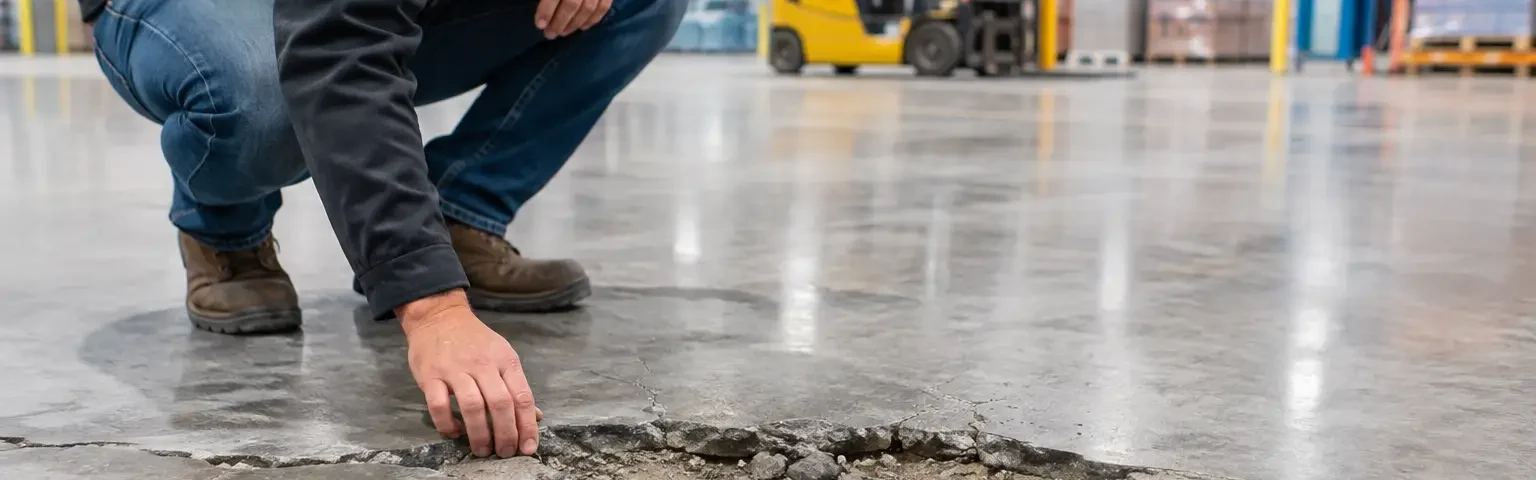
A forklift wheel catches on a shallow crater near a production line. A sanitation crew finds loose concrete along a washdown area. Small chips become larger breaks around a cold-storage door. This is how concrete spalling often announces itself in a working facility: not as a cosmetic concern, but as a maintenance issue that can affect safety, sanitation, traffic flow, and production.
Concrete spalling is the breaking, flaking, or chipping away of a concrete surface. In commercial and industrial buildings, it can range from isolated surface pop-outs to deep deterioration that exposes reinforcing steel or leaves a slab unable to handle intended loads. The correct repair depends on why the concrete failed, how far the damage extends, and what the floor must withstand after it returns to service.
What Concrete Spalling Looks Like on a Working Floor
Spalling is often mistaken for ordinary wear because it commonly begins at the surface. The difference is that spalled concrete has lost bond or strength. It may appear as rough, broken patches; shallow pits; delaminated areas that sound hollow when tested; crumbling slab edges; or deteriorated joints under repeated forklift traffic.
The location offers useful clues. Damage concentrated around drains, washdown zones, freezers, loading docks, and chemical handling areas usually points to environmental exposure or moisture. Spalling along travel lanes, rack legs, and door thresholds may reflect impact, vibration, heavy point loads, or inadequate joint performance. When the damage is widespread, a facility may be dealing with a broader placement, curing, moisture, or coating-system issue rather than a series of isolated failures.
The practical concern is progressive failure. A small weak area can break down quickly once tires, carts, pallet jacks, and cleaning equipment repeatedly hit its edges. The opening collects water and contaminants, surrounding concrete loses support, and the repair area grows. In food processing and commercial kitchens, damaged concrete can also create sanitation challenges that cannot be solved by routine cleaning.
Why Concrete Spalling Happens
Concrete is durable, but it is not immune to the conditions common in industrial facilities. Spalling rarely has a single cause. A proper evaluation looks at the slab, its environment, its history, and the demands placed on it.
Moisture and freeze-thaw exposure
Water entering concrete pores can be especially destructive where temperatures cycle below freezing. As trapped moisture freezes, it expands and creates internal pressure. Over repeated cycles, the surface separates and breaks away. This is a familiar issue at exterior loading areas, but it can also affect cold-storage entries, freezer transitions, and other locations where condensation and temperature changes are constant.
Moisture matters even when freezing is not involved. Persistent water intrusion can weaken concrete, carry contaminants below the surface, and contribute to corrosion in reinforcing steel. If steel begins to corrode, it expands and pushes the surrounding concrete outward, causing cracking and deeper spalling.
Chemical attack and washdown conditions
Food and beverage facilities, breweries, commercial kitchens, and manufacturing plants may expose floors to acids, alkalis, oils, salts, cleaners, and process liquids. Some materials attack the cement paste in concrete directly. Others penetrate through cracks or porous areas and cause gradual deterioration below the visible surface.
A floor exposed to frequent hot-water washdown faces an added challenge. Thermal cycling causes concrete and some repair materials to expand and contract at different rates. A patch that looks acceptable at installation can debond after repeated washdowns if the repair system is not designed for thermal shock and chemical exposure.
Poor placement, curing, or finishing
Some failures begin when the slab is installed. Adding excess water to a mix, overworking the surface, finishing during bleed water, or curing poorly can leave weak concrete near the top of the slab. That weak layer may remain hidden for years before traffic, moisture, or coatings reveal the problem.
Surface contamination is another concern. Hardeners, sealers, curing compounds, oils, and old coatings can interfere with the bond of later repairs or flooring systems. Installing a new coating over unsound or contaminated concrete may hide the condition briefly, but it does not correct the underlying failure.
Traffic, impact, and joint distress
Warehouse and manufacturing floors experience concentrated loading in predictable places: forklift routes, battery charging areas, dock approaches, rack aisles, and equipment pads. Repeated wheel impact at uneven joints can fracture slab edges. Once joint shoulders fail, traffic impact increases and deterioration accelerates.
This is why joint repair should not be treated as a cosmetic filler job. In high-traffic facilities, joints need to be evaluated for movement, load transfer, edge condition, and the type of wheels crossing them. A rigid repair in a moving joint can fail. A flexible material where hard-wheel traffic needs edge support can also fail. Fit matters.
Assess the Damage Before Selecting a Repair
The visible surface does not always show the full extent of a spall. A sound repair begins by determining whether the concrete is damaged only near the surface or whether the slab has deeper deterioration, moisture intrusion, corrosion, or structural distress.
A commercial evaluation commonly includes sounding suspected areas for delamination, mapping cracks and spalls, checking joint conditions, identifying moisture sources, and reviewing traffic patterns and process exposure. Where necessary, the repair plan should account for concrete strength, reinforcement condition, slab movement, drainage, and the requirements of any flooring system planned for the area.
The key question is not simply, “What can fill this hole?” It is, “What caused this concrete to fail, and what will this floor face every day after repair?” A patch at a forklift intersection needs a different design than one beside a drain in a hot washdown room. A slab with corroded reinforcement requires more than a surface-applied material.
Concrete Spalling Repair That Holds Up
Long-lasting industrial concrete repair starts with removal. All loose, weak, and contaminated concrete must be taken out until sound substrate is reached. Depending on the condition, that may involve saw cutting repair boundaries, mechanically removing deteriorated material, cleaning exposed reinforcement, and preparing the concrete profile for the specified repair product.
Preparation is where many repairs succeed or fail. The replacement material must bond to clean, properly profiled concrete. If moisture, oil, laitance, or damaged concrete remains, the new repair is only attached to the old problem. Edge geometry also matters. Feathered edges tend to break under traffic, so repair areas need sound, durable termination details.
The repair material should match the service environment. Rapid-setting repair mortars can reduce downtime in busy facilities, but fast return to service is not the only consideration. Material selection must also account for thickness, compressive strength, thermal movement, chemical exposure, moisture, and the need for a compatible finish or coating.
For floors in wet processing, food production, breweries, and commercial kitchens, a properly prepared repair may be followed by a urethane cement flooring system. Urethane cement is often selected where thermal shock, frequent washdown, moisture vapor, and aggressive sanitation conditions make conventional coatings a poor fit. The goal is not to coat over failing concrete, but to restore the substrate and install a system suited to the operation.
In warehouses, distribution centers, and manufacturing environments, repairs may be paired with concrete grinding, joint restoration, concrete sealing, or polished concrete work depending on the desired floor performance. Polished concrete can be a strong option for appropriate dry-use facilities, but it will not correct active moisture problems, severe chemical exposure, or unresolved slab movement. The floor system has to follow the use case.
When a Patch Is Not Enough
A localized repair is appropriate when damage is limited and the surrounding concrete is sound. It is not the right answer when spalling is extensive, reinforcement corrosion is active, water is entering beneath the slab, or the floor is experiencing structural movement and repeated failure.
Warning signs include repairs that break out along the same traffic path, widespread hollow areas, recurring deterioration around drains or freezer doors, exposed reinforcing steel, significant cracking, and surface loss that changes floor elevation or drainage. These conditions call for an engineer-led approach that separates cosmetic symptoms from structural or environmental causes.
Operational planning matters as much as material selection. Facilities may need phasing around production schedules, cure-time requirements, traffic restrictions, sanitation procedures, and temperature controls. A repair that is technically correct but disrupts a critical production area without a workable sequence is not a complete solution.
The best time to address spalling is before broken concrete creates a larger safety, sanitation, or equipment problem. Document recurring locations, note what the area is exposed to, and have the slab evaluated before selecting a repair material or flooring finish. Sound preparation and a repair design matched to actual service conditions give the floor a better chance of staying in service.
Need a commercial or industrial flooring solution? TKO Concrete Coatings provides concrete restoration and high-performance flooring systems for manufacturing plants, food-processing facilities, warehouses, commercial kitchens, breweries, and other demanding environments. Visit TKOConcrete.com to discuss your project or request an evaluation.
