
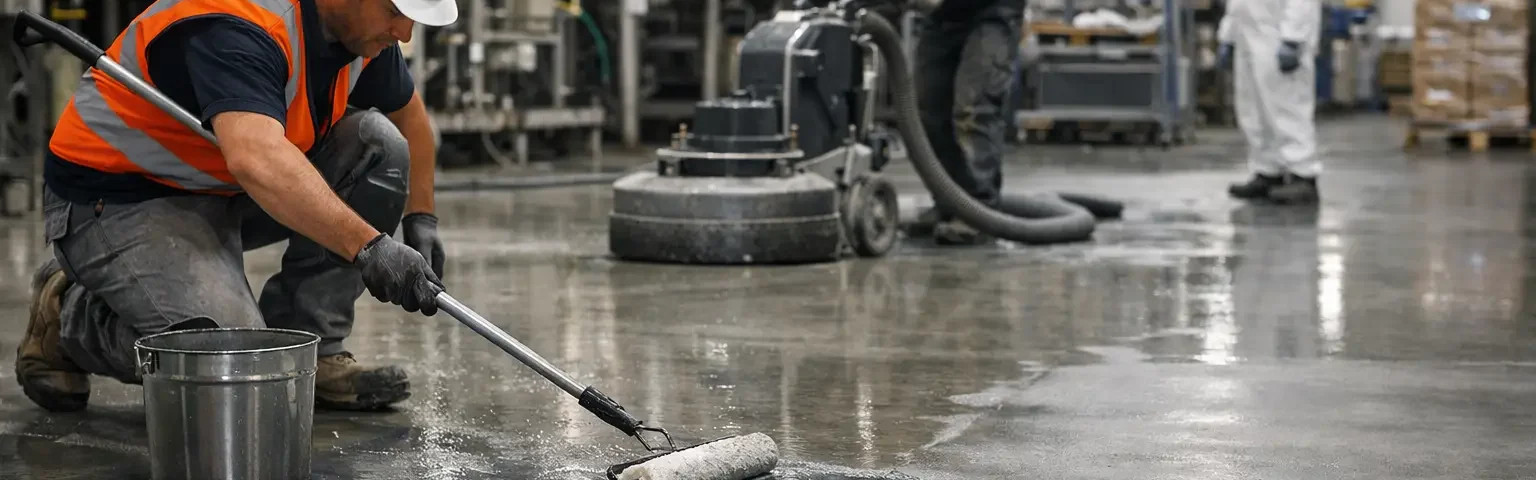
A warehouse floor can look acceptable at the start of a shift and still be losing performance every day. Forklift traffic opens the surface, dust develops at wheel paths, washdown water finds weak areas, and contaminants settle into pores that were never properly protected. Concrete sealing is often an effective way to reduce those risks, but only when it is treated as a flooring decision rather than a quick maintenance item.
For commercial and industrial facilities, the right sealer can improve cleanability, limit dusting, reduce liquid absorption, and extend the usable life of a sound slab. The wrong material, or a sealer applied over unresolved damage, can leave a facility with peeling film, slippery conditions, trapped moisture, and another shutdown to correct the problem.
What Concrete Sealing Actually Does
Concrete is porous. Even dense, hard-troweled concrete has capillaries that can take in water, oils, cleaning solutions, process fluids, and other contaminants. Over time, that exposure can contribute to staining, surface wear, freeze-thaw damage in exterior loading areas, and deterioration around joints and cracks.
Concrete sealing changes how the surface responds to that exposure. Some sealers penetrate the slab and reduce absorption below the surface. Others form a protective film that improves stain resistance, dust control, appearance, or abrasion resistance. Neither approach is automatically better. The right choice depends on the slab condition and the environment above it.
In a dry distribution center, a penetrating treatment may be appropriate for controlling dust while preserving a natural concrete appearance. In a manufacturing area with oil exposure, frequent traffic, and cleaning requirements, a higher-build protective system may be needed. In a food-processing room, brewery, commercial kitchen, or wet process area, sealing alone may not provide the chemical, thermal, and sanitation performance the operation requires. A urethane cement flooring system is often the more durable fit in those conditions.
When Concrete Sealing Is the Right Solution
Sealing works best when the underlying concrete is structurally sound, reasonably flat, and free of active moisture-related failure. It is a protection strategy, not a substitute for repair.
A facility may be a strong candidate for sealing when its floor is beginning to dust, showing light surface wear, absorbing incidental spills, or becoming difficult to keep clean. It can also make sense after concrete grinding has removed weak surface material or prepared an existing slab for a more consistent finish. In polished concrete applications, densification and guard products may be part of the process used to improve hardness, stain resistance, and maintenance performance.
The expected service conditions matter most. A sealed floor in a light-duty storage area has a very different job than a floor beneath loaded forklifts, pallet jacks, steel-wheeled carts, or manufacturing equipment. Traffic patterns, turning movements, point loads, chemical exposure, temperature swings, and cleaning methods should guide the recommendation.
Sealing is usually not the right standalone answer when a floor has widespread delamination, active cracks, failed joints, significant spalling, moisture vapor issues, or loss of slab integrity. Those conditions require a closer evaluation and, often, industrial concrete repair before a protective treatment is considered. Applying sealer over deteriorating concrete only makes the failure less visible for a short period.
Surface Preparation Determines Whether the Sealer Performs
Most sealer failures begin before the material is applied. Dust, oil, curing compounds, old coatings, weak laitance, and incompatible previous treatments can all prevent proper penetration or adhesion. A clean-looking floor is not necessarily a prepared floor.
The preparation method should match the selected system. Mechanical profiling through grinding or shot blasting may be needed for film-forming products that require a reliable bond. Penetrating sealers still require a clean, open surface free of contaminants that can block absorption. In either case, the slab must be dry enough for the product and assessed for moisture conditions that could affect performance.
Joint and crack conditions also need attention before sealing. Joints carry movement, and rigid repairs in moving locations often fail prematurely. Cracks may be dormant, active, structural, or simply signs of a deeper issue. An experienced contractor evaluates the cause before selecting a repair material and deciding whether the surrounding floor is suitable for a sealer, a coating, or a more extensive restoration system.
This is where facility managers can avoid a common budget mistake. Skipping preparation may reduce the initial proposal price, but it raises the likelihood of premature wear, adhesion loss, and unplanned downtime. The material is only one part of the flooring system. Preparation, repair, installation conditions, and cure time determine whether it holds up in service.
Choosing a Sealer for the Operating Environment
There is no universal concrete sealer for industrial facilities. The decision should be based on how the floor is used, what it contacts, and what happens if the protection fails.
Penetrating sealers are often selected for reducing water and contaminant absorption without creating a visible surface film. They can be useful where maintaining traction and the natural look of concrete are priorities. Their limitations are equally important: they do not typically provide the same level of chemical resistance, color uniformity, or surface-build protection as a coating system.
Film-forming sealers can offer stronger stain resistance and a more controlled appearance. Depending on the chemistry, they may improve dust proofing and make routine cleaning easier. However, they can wear in traffic lanes, require careful surface preparation, and may become problematic if moisture pushes upward through the slab. Slip resistance should also be evaluated, particularly in washdown zones, entrances, loading areas, and locations where liquids are routinely present.
For demanding wet and chemical-exposure environments, a facility should look beyond basic sealing. Food Processing Flooring must account for sanitation protocols, organic acids, hot-water washdown, and thermal shock. Urethane Cement Flooring is frequently specified where moisture tolerance, chemical resistance, and temperature cycling exceed what a conventional sealer can manage. The goal is not to install the thinnest or least expensive system. It is to install the system that matches the failure risks of the operation.
Plan Installation Around Operations, Not Just Square Footage
A concrete sealing project affects more than the floor. Equipment access, traffic rerouting, cure schedules, ventilation, sanitation requirements, and production windows all need to be addressed before work begins.
For an occupied warehouse, work may need to proceed in phases so shipping and receiving can continue. In a manufacturing plant, the installation window may be tied to a planned outage. In food and beverage facilities, containment and cleanup procedures are central to protecting adjacent operations. A contractor who understands industrial work plans the sequence around the facility rather than assuming the floor is an empty box.
The schedule should also allow for proper cure time before traffic returns. Reopening too early can mark the surface, compromise the finish, or shorten its service life. Temperature and humidity affect cure behavior as well, especially in Tennessee facilities where seasonal conditions can change quickly. A realistic schedule protects the investment and reduces surprises for operations teams.
Maintenance Still Matters After Sealing
A sealed floor is easier to maintain, not maintenance-free. Abrasive debris should be removed before it is ground into traffic lanes. Cleaning products should be compatible with the sealer chemistry. Spills should be addressed promptly, even on protected concrete, because exposure time and concentration still matter.
Facility teams should inspect high-traffic areas, joints, drains, doorways, and equipment pads regularly. These are often the first locations to show wear or moisture-related problems. Early touch-up or localized repair can prevent a small issue from expanding into a larger restoration project.
The best flooring decision starts with an honest assessment of the slab, the process, and the consequences of failure. When concrete is sound and the exposure is appropriate, sealing can provide practical, cost-effective protection. When the environment is harsher, a more engineered repair or high-performance flooring system protects both the floor and the operation that depends on it.
Need a commercial or industrial flooring solution? TKO Concrete Coatings provides concrete restoration and high-performance flooring systems for manufacturing plants, food-processing facilities, warehouses, commercial kitchens, breweries, and other demanding environments. Visit TKOConcrete.com to discuss your project or request an evaluation.
