
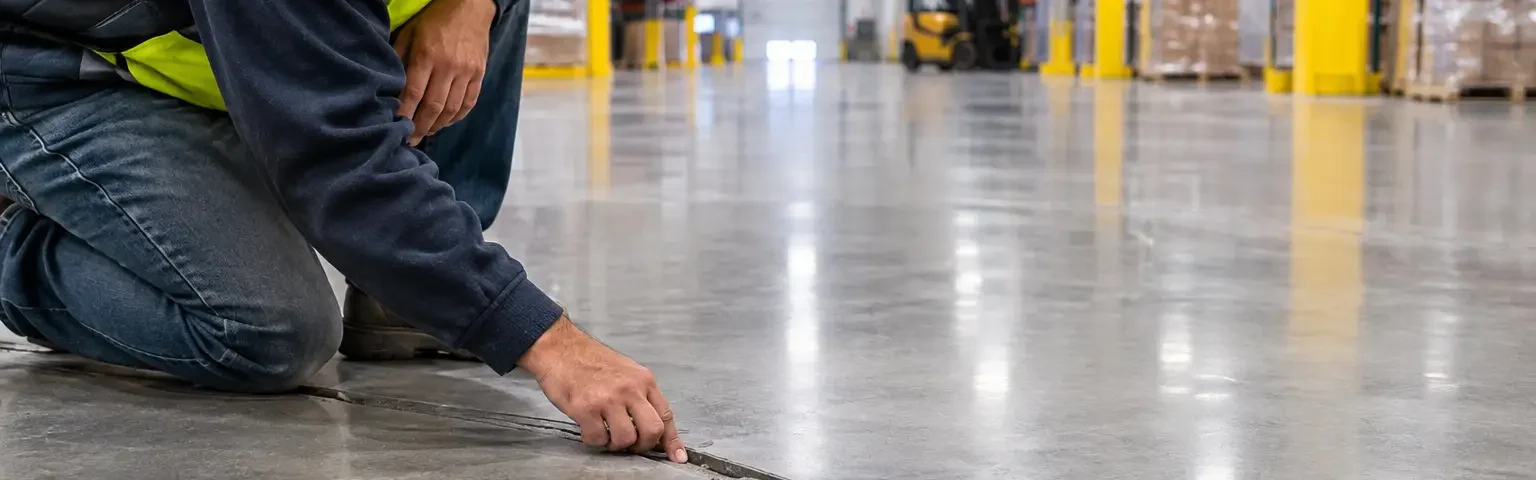
A failed floor joint rarely starts as a small problem for long. In a warehouse, plant, processing facility, or commercial kitchen, a chipped joint edge can quickly become a source of forklift impact, loose debris, sanitation concerns, equipment vibration, and repeated maintenance calls. Understanding why concrete joints fail helps facility teams address the cause rather than repeatedly patching the visible damage.
Concrete joints are intentional weak points. They are placed to control cracking, accommodate slab movement, and divide a large floor into manageable sections. The trouble begins when the joint design, concrete condition, traffic pattern, repair material, or operating environment does not match the demands placed on the slab.
Why Concrete Joints Fail Under Industrial Traffic
Most industrial joint failures involve a combination of movement and impact. Forklift wheels, pallet jacks, carts, lift trucks, and loaded trailers repeatedly cross the same joint lines. When one slab panel settles, curls, cracks, or moves differently than the panel beside it, the joint edge is exposed to a pounding force it was never meant to carry alone.
A sound concrete slab can still have vulnerable joints. Concrete shrinks as it cures, and slabs respond to changes in temperature and moisture. In cold storage, food processing, breweries, and washdown areas, those changes can be frequent and severe. Joints must allow for expected movement while remaining durable enough to support the traffic and cleaning conditions in the space.
When a joint opens, weakens, or loses support underneath, wheel loads strike the exposed edges. The result is commonly called joint spalling: broken, fractured, or crumbling concrete along one or both sides of the joint. Once spalling starts, every crossing enlarges the damaged area.
The Conditions Behind Joint Damage
Differential slab movement
Adjacent slab panels do not always move as one. Curling is a common example. It occurs when the top and bottom of a slab have different moisture or temperature conditions, causing edges or corners to lift slightly. A forklift traveling across a curled joint can make the slab edge deflect repeatedly, eventually breaking down the concrete.
Settlement can create the same effect. If subbase support deteriorates, voids develop, or the slab was placed over poorly prepared material, one side of the joint may sit lower than the other. A surface repair alone will not last if the slab continues to move or lacks support below.
High wheel loads and hard-wheeled equipment
Industrial floors do not experience traffic evenly. Operators tend to follow the same travel aisles, and trucks often turn, brake, or stage loads in predictable locations. Solid tires and narrow wheels concentrate force at the joint edge. A joint near a rack aisle, dock approach, processing line, or production bottleneck may receive thousands of damaging impacts every week.
The severity depends on more than vehicle weight. Wheel type, tire hardness, speed, load distribution, turning movement, and the angle at which equipment crosses a joint all affect performance. A joint that holds up in a lightly used storage area may fail quickly in a busy distribution aisle.
Inadequate joint fill or the wrong filler
Joint fillers are often misunderstood. In many industrial applications, their primary job is to support joint edges against wheel impact, not simply seal a gap. A soft, low-strength filler can tear, compress, or pull away under traffic. It may keep debris out for a time, but it will not adequately protect the concrete arris, or sharp joint edge.
At the other extreme, a rigid filler may not be appropriate where significant movement is expected. The right repair approach depends on joint type, slab movement, traffic conditions, exposure to chemicals or moisture, and the operating temperature of the facility. Filling every joint with the same material is rarely a reliable strategy.
Moisture, chemicals, and washdown exposure
Facilities with wet processes have added risks. Water and chemical solutions can work into open joints, weaken surrounding concrete, carry contaminants below the slab, and accelerate deterioration. In food and beverage operations, joint damage can create difficult-to-clean areas that conflict with sanitation requirements.
Acids, oils, caustics, salts, and cleaning chemicals can also affect repair materials differently. A repair product that works well in a dry warehouse may fail prematurely in a brewery, commercial kitchen, or food processing plant. This is one reason flooring and joint repairs should be specified for the actual service environment, not just selected based on initial cost.
Poor saw-cut timing and joint layout
Control joints need to be cut at the right time and depth to encourage cracking below the joint rather than randomly across the slab. Cuts made too late, too shallow, or in an unsuitable layout can allow uncontrolled cracks to form. Those cracks may intersect traffic routes, create uneven transitions, and add stress to adjacent joints.
Joint layout also matters around columns, doorways, drains, equipment pads, and changes in slab geometry. A floor is not simply a flat surface. It is a working system with traffic lanes, drainage requirements, equipment loads, and thermal conditions that must be considered during design and construction.
Why Quick Joint Patches Often Fail
A failed joint is tempting to treat as a surface defect: remove loose concrete, install a patch, and reopen the lane. That approach may restore appearance temporarily, but it often misses the reason the joint broke down.
If a repair is installed over unsound concrete, it has no dependable edge to bond to. If the joint remains active but is bridged with a rigid patch, movement can crack the repair. If the repair area is not properly cleaned, profiled, dried, and prepared, bond failure is likely. And if the floor continues to receive repeated impact from a rocking slab edge, even a high-strength material can fail.
Downtime pressures are real, particularly in active manufacturing and distribution facilities. Still, rushing preparation is one of the costliest ways to handle joint damage. A repair must be designed around the operating conditions and installed within the material’s preparation, temperature, and cure requirements.
A Better Process for Industrial Joint Repair
A lasting repair starts with evaluation. The goal is to determine whether the problem is isolated edge damage or evidence of a larger slab issue. Facility managers should look for rocking panels, widening cracks, settled areas, deteriorated joint filler, moisture intrusion, repeated failures in one traffic lane, and damage that returns shortly after repair.
The repair scope may include removing deteriorated concrete to sound material, rebuilding joint edges with a compatible high-strength repair system, correcting unsupported areas when necessary, and installing a traffic-rated filler where appropriate. In some facilities, joints also need protection from chemical exposure, washdown, or thermal cycling.
Preparation is not a background task. Mechanical removal, crack routing, cleaning, surface profiling, and moisture assessment all influence the outcome. For operating facilities, the repair sequence should also account for safety, access, staging, cure time, and how equipment will be routed during the work.
When the surrounding floor needs attention
Joint failure can be an early warning sign that the broader floor system needs restoration. Widespread spalling, scaling, cracking, surface erosion, and chemical damage may call for a larger industrial concrete repair plan rather than a series of isolated patches.
In wet, sanitary, or thermal-shock environments, a properly prepared urethane cement flooring system can provide added protection over deteriorated concrete in the right application. The system must be integrated with drains, transitions, wall details, and joint strategy. Coating over moving or failed joints without addressing their function merely transfers the problem to the new surface.
For dry commercial and industrial spaces, concrete grinding, densification, sealing, or polished concrete may improve cleanability and wear resistance after repairs are complete. Those options are useful only when the underlying slab condition and intended traffic support them.
Preventing Repeat Failures
The most effective prevention is to treat joints as a maintenance priority, not a cosmetic detail. Inspect high-traffic aisles regularly, especially near dock doors, freezers, washdown areas, production lines, and racking. Small edge breaks, missing filler, and early cracking are less disruptive to repair before they become broad spalls or trip hazards.
Document where damage occurs and how equipment moves through the area. Repeated failure at the same joint usually points to a specific operating condition: heavy loads, turning traffic, slab movement, moisture, drainage, or an incompatible prior repair. That information gives an experienced contractor and engineer a better basis for selecting the right solution.
The practical goal is not to eliminate every joint. It is to preserve each joint’s intended function while protecting the surrounding concrete from the conditions that cause damage. When repair design matches the slab, traffic, and environment, joint work becomes a long-term floor performance investment rather than another recurring shutdown item.
Need a commercial or industrial flooring solution? TKO Concrete Coatings provides concrete restoration and high-performance flooring systems for manufacturing plants, food-processing facilities, warehouses, commercial kitchens, breweries, and other demanding environments. Visit TKOConcrete.com to discuss your project or request an evaluation.
