
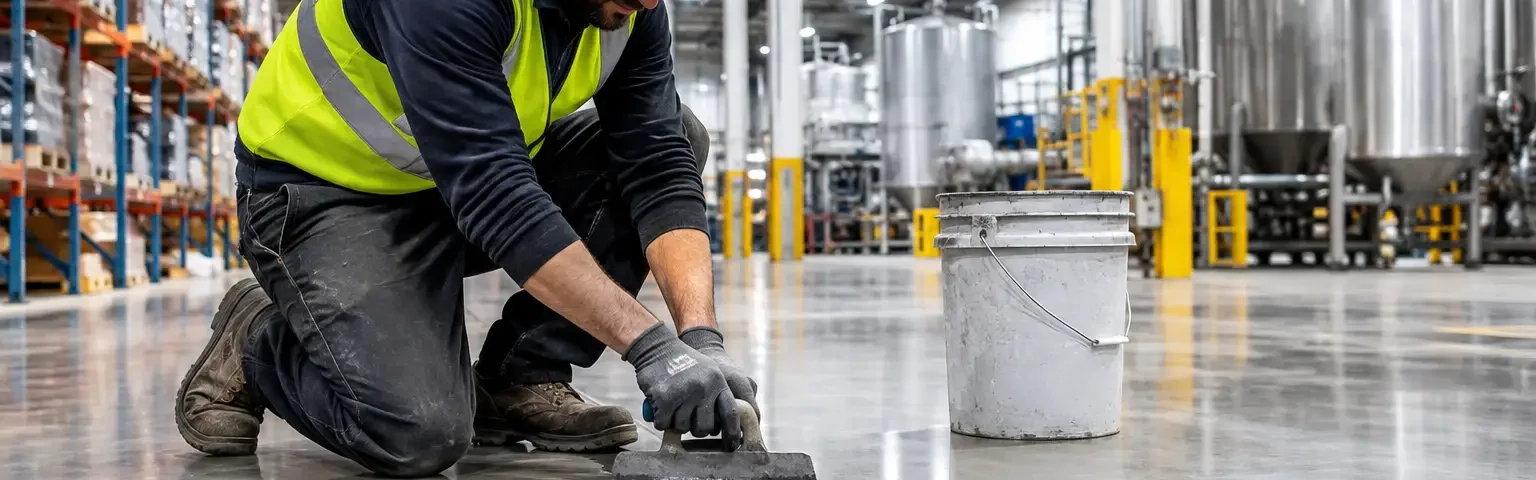
Forklift wheels do not forgive unsupported joint edges. Once a joint filler tears out or sits below the slab surface, repeated hard-wheel traffic chips the concrete arris, widens the failure, and turns a maintenance issue into a concrete repair project. The best concrete joint fillers are not simply the hardest or fastest-curing products. They are the materials that match the joint type, slab movement, traffic pattern, sanitation requirements, and operating conditions of the facility.
For warehouses, manufacturing plants, food-processing facilities, commercial kitchens, and distribution centers, the correct joint system protects more than appearance. It helps preserve slab edges, reduce equipment vibration, limit debris collection, and extend the useful life of the floor.
What a Concrete Joint Filler Must Do
Concrete joints serve different purposes, and confusing them is a common reason repairs fail. Saw-cut control joints are intended to manage shrinkage cracking as the slab cures. In industrial floors carrying forklifts, pallet jacks, carts, or wheeled racks, these joints need edge support. A semi-rigid filler is typically used to fill the full joint depth and support traffic crossing the joint.
Expansion, isolation, and building movement joints are different. They are designed to open and close as slabs, walls, equipment pads, or separate building sections move. These locations generally require a flexible sealant system rather than a semi-rigid joint filler. Installing a hard filler in a true movement joint can lead to cohesive failure, adhesive failure, or damage to the surrounding concrete.
A sound specification starts by identifying the joint’s function. Then it accounts for whether the slab is new or existing, how much the joint has opened, whether edges are already broken, and what crosses it every day.
Best Concrete Joint Fillers by Industrial Application
There is no single product that is best for every facility. In most high-traffic slab-on-ground applications, the leading choices are semi-rigid epoxy fillers and semi-rigid polyurea fillers. Each can perform well when selected and installed correctly.
Semi-rigid epoxy joint fillers
Semi-rigid epoxy remains a proven option for many interior industrial floors. It cures into a firm material that supports joint shoulders under wheeled traffic, helping transfer loads across the joint and protect vulnerable arrises. Epoxy fillers are commonly used in warehouses, manufacturing areas, distribution centers, and other environments where forklifts follow consistent travel paths.
The trade-off is that epoxy is generally more rigid and may have a longer cure time than polyurea. It is often best suited to joints that have largely completed their initial shrinkage movement or where the operational schedule allows proper cure time before traffic returns. Surface temperature, slab moisture, joint cleanliness, and correct mixing all matter. A filler installed over dust, oil, weak concrete, or standing moisture may not bond as intended, regardless of product quality.
Semi-rigid polyurea joint fillers
Semi-rigid polyurea is often the practical choice when a facility needs a rapid return to service. It can cure quickly, which makes it useful for active production areas, logistics facilities, and phased repair work where downtime must be tightly controlled. Like epoxy, a properly selected polyurea filler supports joint edges under hard-wheeled traffic.
Polyurea also comes in a range of hardness levels and formulations. That matters because not every product behaves the same way in a cold facility, a hot production area, or a slab with ongoing movement. Some formulations are better suited to low-temperature installation or can accommodate modest joint movement more effectively than conventional epoxy. Fast cure is valuable, but it does not replace preparation. The joint still needs to be cleaned, properly routed where necessary, dry enough for the specified product, and filled to the correct depth.
Flexible polyurethane and silicone sealants
For true expansion or isolation joints, flexible polyurethane or silicone sealants are usually the appropriate category. These materials are designed to stretch and compress rather than provide rigid edge support. They are often installed over properly sized backer rod so the sealant has the right depth and bond geometry.
The choice between polyurethane and silicone depends on conditions. Chemical exposure, wet cleaning, temperature swings, UV exposure, and the required movement capability all affect the decision. In food and beverage environments, the joint system must also stand up to frequent washdown and the chemicals used in sanitation procedures. A flexible sealant may be the correct answer at a perimeter or building movement joint, but it is generally not the right repair for a forklift-traveled control joint.
Joint Filler Selection Starts With Traffic and Movement
The first question is not, “Which filler is strongest?” It is, “What is this joint required to do?” A warehouse slab with constant lift-truck traffic needs joint edge support. A freezer threshold may need a material that performs under low temperatures and accommodates temperature-driven movement. A manufacturing area with aggressive washdown needs a compatible material and a detail that does not create a debris-catching gap.
Consider these conditions before specifying a filler:
- Traffic type, wheel hardness, load weight, and travel frequency
- Joint type, width, depth, and the amount of expected movement
- Existing spalls, broken arrises, delaminated edges, or slab settlement
- Moisture exposure, washdown cycles, chemicals, oils, and cleaning agents
- Installation temperature, ambient conditions, and allowed downtime
Forklift traffic deserves particular attention. Hard nylon, polyurethane, and steel wheels place concentrated stress directly on joint shoulders. When the filler is too soft, installed too low, or poorly bonded, the concrete edge takes the impact. Once the edge begins to break, filling the joint alone may not be enough. The repair may require rebuilding the arris with an appropriate rapid-setting repair mortar before the joint is refilled.
Why Joint Fillers Fail in Commercial Facilities
Most premature failures trace back to the condition of the joint or the wrong product category, not a lack of filler material. Joint walls contaminated by dust, old sealant, oils, curing compounds, or weak concrete prevent dependable adhesion. Filling a joint before it has opened sufficiently can also lead to later damage as the slab continues to shrink.
Depth is another frequent issue. Semi-rigid fillers should be installed according to the manufacturer’s requirements and the project detail, not treated as a shallow cosmetic bead. On existing floors, joints are commonly cleaned and routed as needed to create sound, consistent joint walls. After filling, some systems are allowed to overfill slightly and then shaved flush once cured. This helps avoid a recessed joint that catches wheels and invites edge damage.
A repair can also fail because it addresses only the visible crack. If recurring impact, slab movement, moisture, or deterioration beneath the surface is driving the damage, the joint needs a broader evaluation. Engineer-led Industrial Concrete Repair is particularly valuable where joint failure is connected to structural slab concerns, widespread deterioration, or repeated equipment traffic.
Preparation Is the Difference Between Filling and Repairing
A durable joint repair begins with a site-specific assessment. The contractor should identify joint types, measure widths, inspect edge damage, map traffic lanes, and review operating conditions before recommending a material. In active plants, the work plan should also address containment, dust control, access, cure time, and how the area will return to service.
Preparation generally includes removing failed material, cleaning the joint to sound concrete, repairing deteriorated edges, and confirming that the joint is dry and ready for the selected filler. Mechanical preparation is often necessary where old materials are tightly bonded or joint walls are weak. Proper floor preparation is especially important before installing seamless systems such as Urethane Cement Flooring, where joint treatment and substrate repairs affect long-term performance.
In wet processing spaces, joint repairs should be coordinated with the complete floor system. A floor exposed to thermal cycling, hot-water washdown, acids, sugars, fats, or caustic cleaning requires more than a generic filler recommendation. The joint detail, concrete repair material, and protective flooring system must work together. This is why Food Processing Flooring projects benefit from evaluating joints before coating or resurfacing begins.
When a Joint Repair Needs More Than Filler
If joints are extensively spalled, slab panels have settled, or cracks are moving independently of the control joint pattern, a simple refill may only delay the next failure. Repairing the concrete edges, stabilizing affected areas, correcting drainage conditions, or addressing underlying moisture may be necessary first.
For a polished concrete floor, joint treatment also affects the final appearance and maintenance profile. For coated or resurfaced floors, transitions, terminations, and movement joints need to remain functional rather than being buried under a rigid topping. The right approach protects the floor system while keeping the facility practical to clean, operate, and maintain.
The best result comes from treating joints as working parts of an industrial floor, not as lines to be covered. A filler chosen for the actual traffic, movement, and exposure conditions can protect slab edges and reduce disruptive repairs later.
Need a commercial or industrial flooring solution? TKO Concrete Coatings provides concrete restoration and high-performance flooring systems for manufacturing plants, food-processing facilities, warehouses, commercial kitchens, breweries, and other demanding environments. Visit TKOConcrete.com to discuss your project or request an evaluation.
